
Virtual Fencing: Where It Makes Sense — and Where It Doesn’t
The time and resources saved by using virtual fencing might depend on a rancher’s grazing management plan.
Rotational or adaptive multi-paddock grazing (AMP), a method of grazing in which livestock are moved to new pasture at frequentintervals, requires a periodic allocation of time to build fence and move livestock.
For ranchers who are unaccustomed to this style of grazing management, the time and resources required can be a barrier to trying AMP grazing. But Dr. Maria Silveira believes virtual fencing can remove that hurdle in most cases.
“There are benefits for both production and environmental aspect,” says Dr. Silveira. She is the director of research at Noble Research Institute and led a two-year study on virtual fencing as a researcher with the University of Florida.
How it works
Virtual fencing for livestock is a relatively new tool. Less than a decade ago, companies launched a way for ranchers to control livestock distribution without physical barriers.
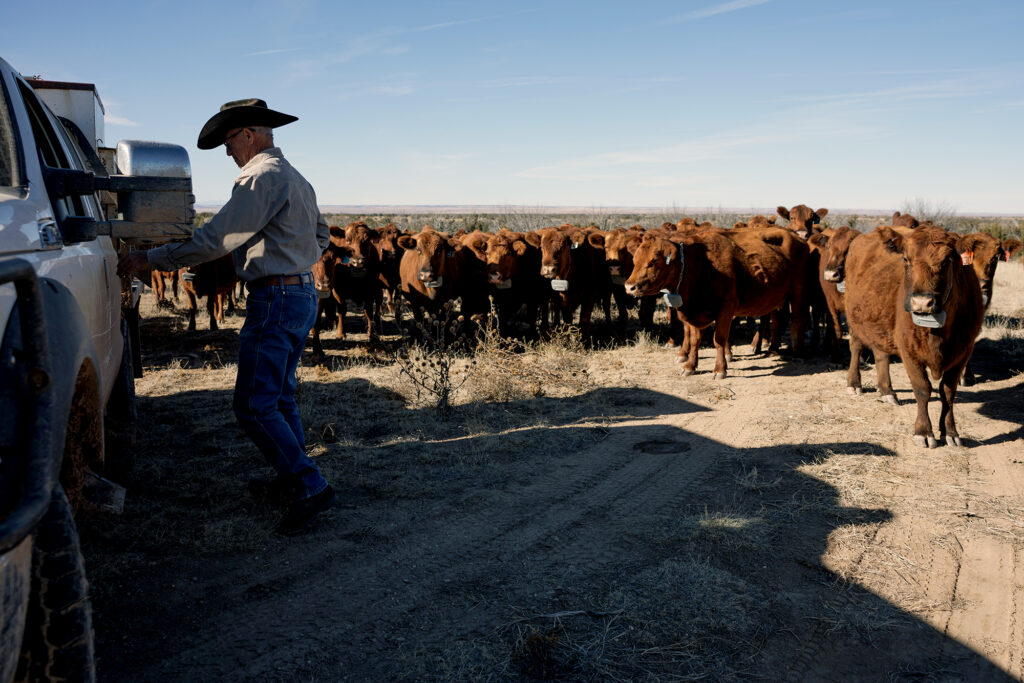
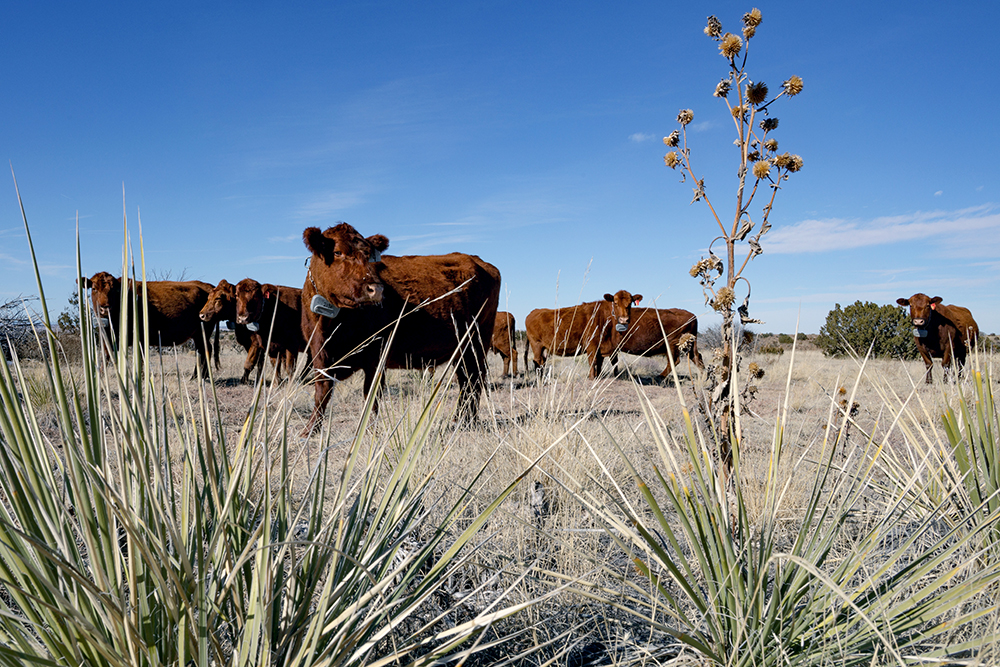
Ranchers have options when it comes to choosing their virtual fencing partner. The technology is similar regardless of the brand printed on the device. Livestock are adorned with a special collar that communicates with GPS and reception towers. Ranchers can create a virtual fence via a smartphone or desktop app. When the livestock reach the limit of the virtual fence, one or moreloud beeps emit from the collar. If livestock continue moving beyond virtual fence’s boundary, livestock receive a benign shock.
“There’s a training period,” says Dr. Silveira of the time needed for the cattle to learn the collar’s feedback system. “The cattle, surprisingly, are very smart. They realize that when they hear the tone, the next step is the shock.”
In most cases, there’s an upfront cost for the towers. The number of towers needed depends on the range of each tower, landscape characteristics and the size of the land base they’ll cover. There’s also an annual subscription fee associated with the collars.
Benefits to pastures
From Dr. Silveira’s perspective, the benefit of the technology depends on a rancher’s grazing management strategy. “It saves time if the person is rotating the cows very frequently, but not as much in a continuous stocking situation,” she says.
She also points out that virtual fencing is a low-labor option, but not no labor. Setting up the towers, collaring livestock and managing fence boundaries and moves from a smartphone or computer all require some time investment. However, with a few clicks of a mouse or taps on a screen, ranchers can improve pasture use and reduce or eliminate ecologically sensitive areas from grazing pressure.
“There are some areas, like in Florida specifically, that are environmentally sensitive areas where we don’t want animals,” explains Dr. Silveira, giving an example of a stream or riparian zones. “We can exclude grazing from those areas. From the production perspective, it helps minimize overgrazing while also improving pasture utilization.”
Virtual fencing is not immune to escapes. Some animals will move beyond the defined virtual boundary, which may require more than the tap of a screen to resolve.
Beyond saving time by not building physical fencing, virtual fencing may also improve pasture use. The flexibility of setting virtual fences from your phone or computer means ranchers can move cattle at the right time, when forage reaches a desirable stage for grazing or rest.
Best grazing applications
Silveira’s research showed benefits to forage production in systems that used virtual fencing systems, which were used in rotational grazing set-ups and compared to physical-fenced, continuous grazing set-ups. But she says it’s an example of a correlation, not a causation.
“That’s not from the virtual fence itself. It’s just the grazing management,” explains Dr. Silveira. “But a major barrier for producers to use rotational grazing is the infrastructure required or the labor if we’re using electric fencing. So even though we cannot tie that directly to virtual fencing, it’s a way to facilitate the adoption of rotational grazing.”
Ranchers who are eager to see the benefits of rotational AMP grazing may find virtual fencing a compelling investment. Dr. Silveira has heard ranchers express hesitation because they believe AMP grazing takes too much time and energy to set up. She offers some advice to reduce that perception.
“Just divide the pasture in half and see what happens,” says Dr. Silveira. If ranchers are receptive to the idea that alternating pastures and letting the forage rest has potential, it could be where using virtual fencing is the most practical option.

Laura Brenner
Laura Brenner, Sr. Content Writer
Laura Brenner is a senior content writer for Noble Research Institute. She’s worked in agricultural communications for over a decade, specializing in nonprofit communications and storytelling. Laura earned a bachelor’s degree from Penn State University and a master’s degree from Purdue University. She resides near her hometown of Lancaster County in south-central Pennsylvania.
Comment