
Ranching in the Smallest Corner of the United States
At Peckham Farm, students learn how grazing decisions impact soil, animals and the bottom line, all on a landscape where every acre counts.
This work is led by Coleman Replogle, the farm manager at Peckham Farm, the university’s teaching and research farm. Replogle did not grow up on a ranch. His family owns a seafood restaurant in Vero Beach, Florida, and he spent his childhood in the restaurant world. But he also spent a lot of time on horseback, and his family took annual trips to guest ranches in Wyoming. Those summers formed his first connection to livestock and the land. Later, a college internship introduced him to holistic grazing and soil health, and he realized he wanted to pursue ranching as his career.
“I did not grow up in agriculture. I grew up in the restaurant business,” Replogle says. “At Chico Basin Ranch, they exposed me to holistic management. It was a deep dive, and I realized this was what I really liked.”
Replogle went through the TCU Ranch Management program to build the technical foundation he lacked. After graduating, he gained experience in Colorado, Hawaii, Montana and Wyoming. Then life turned him east. His wife is from Rhode Island, and when a position opened at Peckham Farm, he took the opportunity.
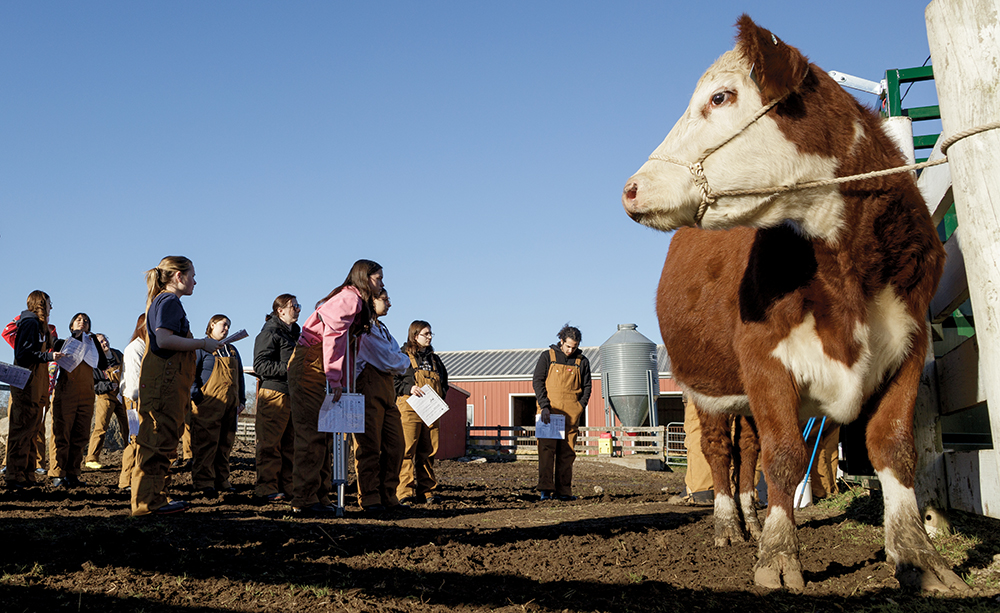
Today, Replogle manages livestock, grazing, facilities, student workers and research coordination on the farm. Peckham Farm has a dual purpose. It is an experiment station where faculty conduct research, and it is also a teaching facility for students who study animal science and veterinary medicine. The farm maintains five livestock species: cattle, sheep, goats, pigs and poultry.
“My job is to provide livestock for students to work with and to manage the land and property on a day-to-day basis,” Replogle says.
Limited Acreage Requires Efficient Grazing
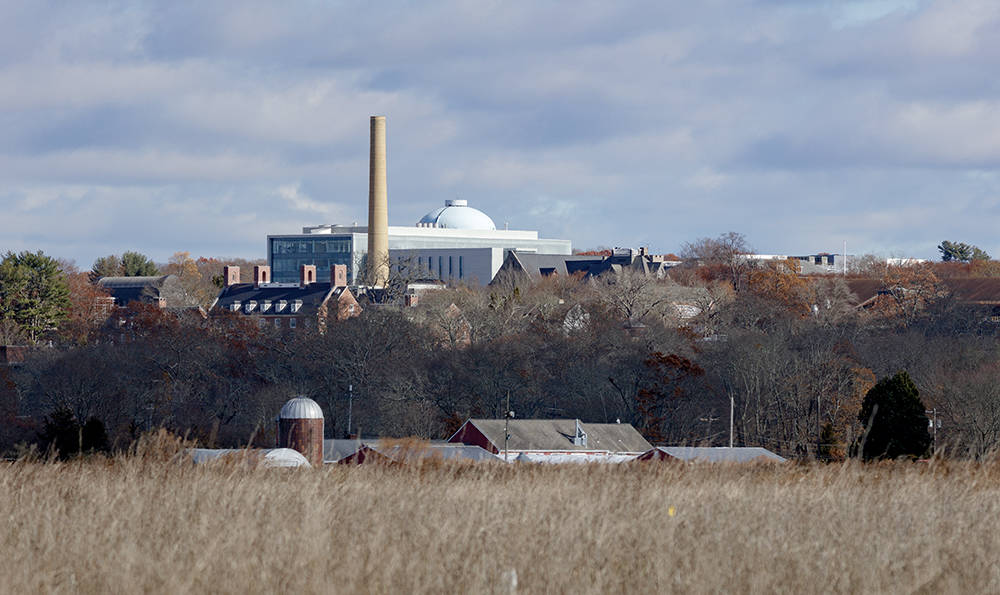
Rhode Island is not a region of large ranches, and land access is one of the biggest challenges for anyone working with livestock in the state. Many farms have been in families for generations or have been purchased by non-agriculture landowners. Leasing land can be difficult and expensive. That means pasture acreage must be used carefully.
“You have to be efficient with your space in order to survive because land is so limited here,” Replogle says.
The climate adds complexity. Rhode Island receives good moisture overall, but the area has experienced short seasonal droughts in late summer during the last few years. When pasture recovery slows, there is very little buffer. Overgrazing one section of pasture can set back the whole rotation.
Peckham Farm already had a rotational system in place when Replogle arrived. Students used a rising plate meter to measure forage availability, and paddocks were rotated accordingly. However, Replogle saw opportunities to improve how the rotations were structured. Some paddocks were too large, which allowed livestock to be selective and left behind significant residual. Other areas did not rest long enough between grazings.
Replogle is now planning to install high-tensile electric lanes, allowing paddock sizes to be adjusted more easily. The goal is to be able to increase or decrease grazing pressure based on forage growth, season and species. This flexibility is especially valuable when working with multiple livestock classes.
The cattle at Peckham Farm include Murray Grey, Hereford and Black Baldy crossbred cows. The sheep flock was originally selected for the show ring, but those genetics struggled on pasture with issues such as hoof health and condition loss. Replogle is transitioning the flock toward forage-based Dorset and Shropshire lines with better parasite resistance and adaptability.
“I have been selecting more of the traditional Dorset sheep, more of the forage-based genetics,” Replogle says. “The previous sheep did not perform well on pasture. They would fall apart.”
Bale Grazing Shows Visible Soil Improvement
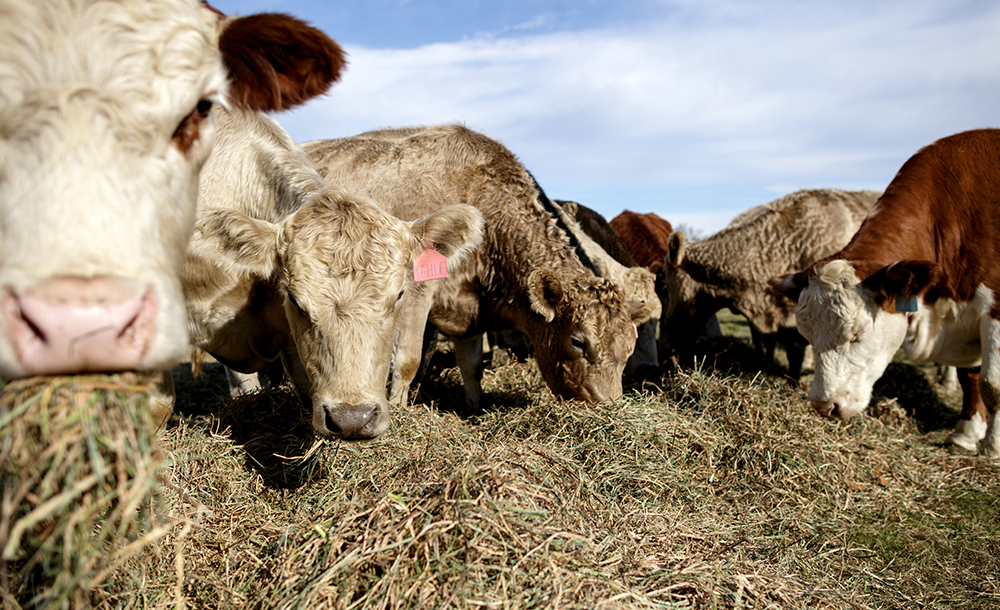
One of the most impactful management changes Replogle has introduced is bale grazing. During winter, hay bales are placed directly on pastures where livestock can access them. The manure and wasted hay provide concentrated fertility in those areas. When moisture and growing conditions return in spring, the impact is visible.
“We do bale grazing in the wintertime,” Replogle says. “In this drought, I was pointing out to students the spots where we bale grazed that were still green.”
“I enjoy getting students who have never stepped foot on a farm but have some interest. Seeing bale-grazed areas staying green was an aha moment for some of them.” — Coleman Replogle
This comparison has been a teaching moment for students who may not have seen soil health principles demonstrated before. The faculty member who monitors soil conditions at Peckham Farm reported significant improvement.
“Since we have started bale grazing, our organic matter has dramatically increased,” Replogle says.
This year, Replogle is pairing bale grazing with frost seeding. Ahead of late winter thaws, he plans to broadcast warm-season and deep-rooted forages and then unroll hay bales over the seeded areas. Cattle will graze and trample the hay, pressing seed into the soil surface. The goal is to increase summer forage resilience and extend grazing later into the season.
“I want to get to the point where we are stockpiling forage and feeding less hay,” Replogle says.
Silvopasture As A Long-Term Strategy
Replogle is also working with faculty members and students to develop a silvopasture section on the farm. Silvopasture refers to managed grazing under widely spaced trees that provide shade, habitat and potential fodder from leaves and branches. This system is especially promising in humid climates where heat stress can reduce animal performance.
Replogle consulted with Noble Research Institute staff when planning this project. The research component will evaluate animal performance and forage characteristics under partial shade compared to open pasture.
The silvopasture area is still in early development, but student interest is strong. One student who originally planned to pursue veterinary work is now interested in research focused on land stewardship and grazing ecology. Replogle sees this as a meaningful outcome.
“I enjoy getting students who have never stepped foot on a farm but have some interest,” Replogle says. “Seeing bale-grazed areas staying green was an aha moment for some of them.”
Managing Within A Shared Mission
Working at a university experiment station offers unique strengths: access to student support, collaboration with research faculty and the chance to try innovative practices in a learning environment. With those opportunities also comes the need to coordinate across multiple academic and research priorities. For instance, some studies call for specfic management approaches, such as maintaining sheep with known parasite susceptibility for a parasitology project.
“My friends like to joke that I ranch with handrails,” Replogle says. “There are guidelines in place, but they exist for good reasons.”
Because purchases and projects follow university processes and class schedules, fencing work or equipment acquisition can require a little more planning. Replogle says Noble’s Business of Grazing course helped him strengthen communication and align expectations early. Now, he leads regular planning conversations with faculty and staff involved in the farm.
“When we’re all on the same page from the start, everything runs more smoothly,” Replogle says.
Goats Fill A Niche On Small Acreage
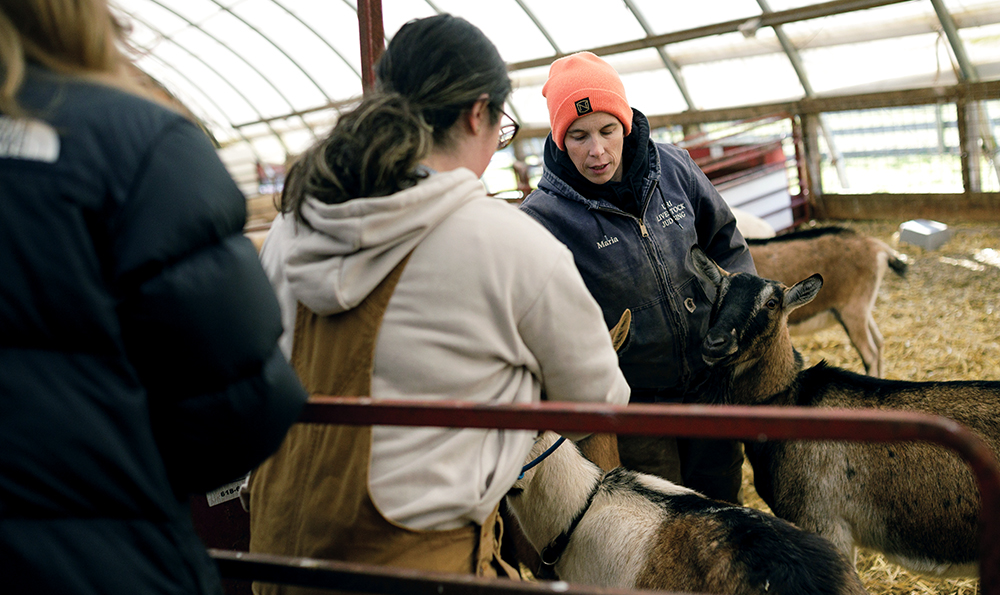
Beyond the university farm, Replogle recently started a targeted goat grazing business that provides brush control services to landowners in the area. Goat browsing fits the landscape well, since Rhode Island has many small properties with dense undergrowth.
“I do not need a ton of acreage to keep 20 to 50 goats,” Replogle says. “It is actually more profitable than if I was just raising meat goats or sheep on my own.”
This business also creates opportunities for his family to be involved and gives students exposure to alternative livestock enterprises.
A Model For Regenerative Ranching In Small Spaces
Rhode Island will never be a large-scale cattle region, but that is not the goal at Peckham Farm. The goal is to improve soil health, livestock performance and grazing literacy among the next generation of agricultural professionals.
The improvements Replogle has seen on the land are measurable. Pastures have more consistent recovery. Organic matter is increasing. Forage diversity is improving. Summer slump periods are moderating. And most importantly, students are learning how animal health, plant health and soil function are connected.
“Be open-minded and think outside the box,” Replogle says. “Do not be afraid to try something new.”
Regenerative grazing is sometimes discussed in the context of thousands of acres. Peckham Farm shows what it looks like on hundreds. The principles remain the same: planned rest, balanced stocking, observation, adaptive decision-making and patience.
Replogle does not claim to have everything figured out. He sees the work as ongoing and experimental. But the progress is clear in the grass itself, and in the students who walk into his office thinking about veterinary school and leave thinking about soil.

Maddy Bezner
Maddy Bezner, Sr. Content Writer
Maddy Bezner is a senior content writer for Noble Research Institute. She grew up in the Texas panhandle as the fifth generation of her family’s farming and cattle feeding business before earning her bachelor’s degree in agricultural communications from Texas A&M University. Maddy’s experience spans marketing and communications within the agricultural commodity and food and beverage industries.
Comment