
Control Encroaching Brush with Goats
Tips from Noble's Ranch Managers for how to best manage goats to control brush and diversify grazing.
Woody brush encroachment on pasture and grazing lands is an ever-present challenge on ranches. Noble’s ranch managers are no strangers to this challenge and offer their advice about how adding goats to your operation can reduce encroachment while adding the benefits of multi-species grazing to your ranch.
Here’s what they’ve learned from their experience at Noble’s Oswalt and Red River Ranches in south-central Oklahoma.
Fencing
To add goats, you’ll first want to modify your fencing to contain a smaller ruminant. We added three additional lines of barbed wire to bring the exterior fences on Oswalt Ranch to an 8-wire fence.
Maintaining a hot fence around goats is more critical than with cattle. Goats are naturally curious animals that like to explore. If a tree or animal damages your fence and it powers down, you’ll find your goats roaming in the neighbor’s yard by the next day. We recommend checking your fence daily and keeping it very hot – somewhere north of 6,000 to 7,000 volts if you can – to discourage meddling.
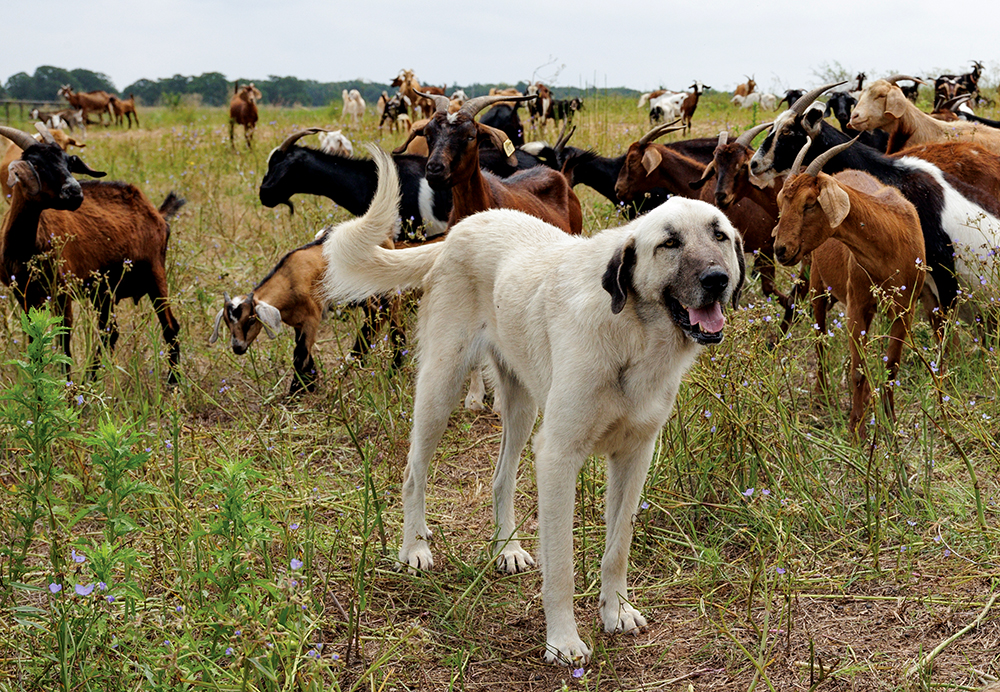
Guardian Dogs
In our experience, having guardian dogs is non-negotiable with goats. It’s important to know that not every dog can be a good guardian dog, however. If you can find a herd that comes with a trained and bonded guard dog, start there when acquiring your goats. Otherwise, use your network to find reputable folks who breed and raise proven guardian dogs.
When grazing multiple species together or near each other, dogs and cows will adjust to each other over time, but there may be some tension between them at first. Allow them time to adapt.
Parasite Prevention
Goats are susceptible to parasites, especially when not managed properly. At Oswalt Ranch, we learned that moving the goat herd frequently helped cut down on the instances of common parasites such as barber’s pole worms (Haemonchus contortus). The grazing rest periods are long enough on this ranch that parasite management isn’t a big challenge. But it’s important to be aware of parasite lifecycles when rotating goats back into sections of pasture.
Multi-species grazing helps break the parasite life cycle, too. Goats and cattle do not share the same parasites, which means goat parasites cannot survive in cattle. Another important part of parasite prevention is keeping a mineral supplement available to the herd to support balanced nutrition.
Rotation Plan
We tested a few ways of grazing goats and cattle on our Oswalt Ranch. The best scenario for both the livestock and grazing management occurred when goats grazed a section first, followed by cattle. The goats thinned out the woody stemmed forages and forbs, leaving the more desirable forages for the cattle.
While goats prefer brush, they will eat forbs and grass, too. If the goal is to leave grass for cattle, the goats need to be rotated to new pastures before their preferred foodstuff runs out. The goats also stayed healthier when they moved faster than the cows. This rotation pace allowed the goats to return to a section of pasture to graze new leaves on the refoliated brush and continue stunting it before regrowth got too far along
A Long-Term Mindset
At our ranches, we found that using goats worked best when large brush and trees were cleared mechanically first. Goats that are brought in after trees are pushed up and burned help clean up the re-emerging forbs and allow the desired grasses to return.
No two ranches will respond to brush control in the same way. It’s important to take the time to observe what the goats are doing and how their presence influences your pastures. Goats are not an overnight fix to brush encroachment; be patient enough to see the plan through.

Comment
Leave a Reply
2 comment on: "Control Encroaching Brush with Goats""
Margaret Gandy
February 18, 2025In our part of the world — Southern Oregon — we’ve run sheep and goats for brush control on our pastures and in the forest lands for fire hardening. What we’ve learned over 25 years:
1) We’ve used both dogs (Anatolians and Great Pyrenees) and donkeys. For my money donkeys make the best predator control. They’ll go up against any predator after ‘their’ sheep and can be kept in 5-7 wire electric fencing, unlike the dogs. Anatolians and Pyres like their evening runs and can and do climb fences and gates. Since donkeys need little in the way of feed inputs beyond what the farm itself provides, feed costs stay low. The main issue has been finding a farrier who knows how to trim donkey hooves. Most horse farriers don’t.
2) When buying goats make sure to ask what the normal feed is on the particular farm you are buying from. We made the mistake of buying a goat herd that had only been on grass pastures. We wanted them for blackberry clearing, usually goat candy. However, if we put this herd in a blackberry patch, they would soon find a way past the fences to the grass pastures and beyond.
3) As to parasites, with managed grazing we never had to worm our animals. An older vet who did not believe we didn’t have rampant parasites tested multiple sites on our 38 acre farm and some of our animals. He could only find a few eggs where the animals gathered for feed. Our animals are on pasture 24/7, constantly moving from one area to another. He was so blown away he wouldn’t charge us for the tests.
Wayne Snelling no
February 25, 2025(I am in my it’s and trying to maintain an active lifestyle. Any ideas on raising cow/calf and goats together for “mature” ranchers? /