
When Are You Regenerative?
Regenerative ranching isn’t a finish line — it’s a mindset shaped by curiosity, cause-and-effect thinking and context.
The question comes up more often than he expected: “When do I call myself regenerative?”
Noble Research Institute’s senior regenerative ranching advisor, Charles Rohla, Ph.D., says he repeatedly fields variations of this question.
He heard it again in a recent conversation with a longtime friend and leader in the silvopasture field — a man with a long, well-respected career and also a growing sense of unease.
For years, the man confidently taught research-backed best practices. As his curiosity about soil health grew, he found himself questioning his own research and the very recommendations he once promoted.
In his own orchards, he was quietly changing course. He added mulching for ground cover and increased carbon cycling. He reduced mowing and herbicide use to encourage biodiversity. He observed insect and disease pressure to respond to management choices in a new light.
And still, he admitted to Rohla, “I’m trying all these things … but I know I’m not regenerative yet.”
Rohla responded: “You are. You’re thinking, you’re observing, you’re adjusting. Regenerative isn’t a title you earn at the end. It’s a mindset you practice along the way.”
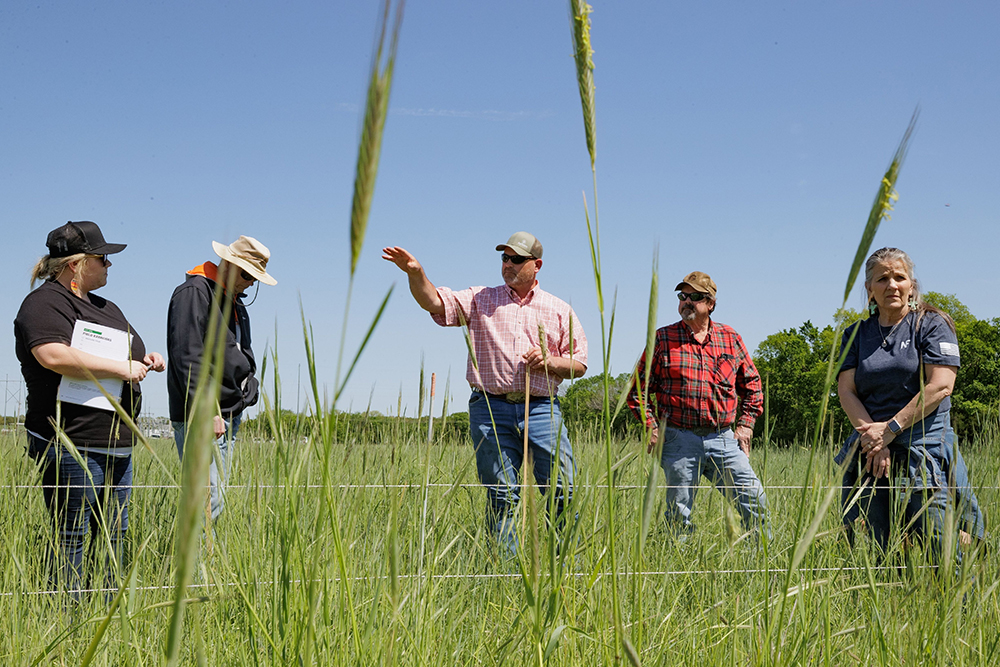
Curiosity First: Learning To See With Unbiased Eyes
Rohla loves opening Noble courses by recalling a day perusing pastures with his then 8-year-old son. Rohla was checking for the presence of dung beetles.
His son lingered. “Dad, is this what you’re looking for?”
He stopped long enough to look again. It wasn’t. But what was it?
Clusters of tiny crustaceans covered the dung pile, busily decomposing and cycling nutrients back into the soil. He sent a photo to an entomologist to identify the pill bugs and learned to see their value in the system.
“That’s a Ph.D. for you,” he says, laughing. “I was so locked into finding what I expected. My son wasn’t looking for anything. He just saw what was there.”
That moment reshaped how he observes. Now, he coaches ranchers to look at their land with childlike curiosity.
“As adults, we bias ourselves by going out with expectations of what we think we should see,” Rohla says. We expect to know exactly what should be growing, what should be grazed and what problems need fixing.
True observation begins when we release those expectations and start to notice what’s actually happening. To do this, tap into all five senses: Feel the soil structure. Note the smell after a rain. Watch how cattle move. Listen for insects. Sit still for a minute or two before concluding.
“Once you get into that child’s mindset, that true curiosity, it changes people.”

Where Research Struggles, Regenerative Reveals Systems
Rohla knows, because he’s been there.
Early in Noble’s transition to studying regenerative ranching, he found himself rethinking some of his own research and wrestling with his own scientific training.
Traditional research relies on deductive, single-variable studies — a method accelerated during World War II when the medical field needed rapid, isolated testing. It’s an effective and efficient system, soon adopted as the university standard.
“The challenge is, once you form a hypothesis, you’ve already put yourself in a box,” Rohla says. “And it’s really hard to look for something other than what you expect.”
He went back and reread his own research, challenging his own assumptions, limits and unintended conclusions. Then, he began rediscovering research from the 1920s and 1930s — decade-long studies that tracked entire systems, not isolated variables.
“These older studies were incredible,” he says. “They looked at the whole operation over time. That’s what regenerative management really is — managing the entirety, not one practice or one outcome.”
Moving From Symptoms To Causes
Curiosity toward the entire system naturally leads to the next shift — replacing symptom-based management with cause-based problem-solving.
Rohla points to weeds as the primary example. It’s easy to see them as a nuisance — a problem to spray, mow or otherwise destroy. But weeds rarely appear without a reason.
“Don’t start with, ‘I have weeds. How do I get rid of them?’” Rohla advises. “Start with, ‘Why do I have these weeds in the first place? What about my management may have led to the bare ground that they’re trying to cover?’”
Once you start to follow that question, the answer often leads back to one or more ecological processes: water cycle, energy flow, nutrient cycling or community dynamics. When those processes are disrupted, the soil health principles are there to help restore harmony — add living roots, increase diversity, cover the soil, optimize disturbance and integrate livestock.
Weeds, bare ground, erosion and low production are all symptoms. Keep digging into the “why” until you find the management choice, ecological process or soil health principle that addresses the core cause.
This quest reveals one of Rohla’s most important regenerative indicators — managing for what you want, rather than against what you don’t want.

Context: The Compass Of Regenerative Management
If there is one underlying theme that anchors every regenerative conversation, it is context.
Rohla uses ultra-high stock density as an example. A million pounds of stock density per acre sounds extreme, and under the wrong conditions, it can be. But used well — in the right place, at the right time, for the proper duration — it can create an ecological hot spot.
“But timing, location and goals have to line up,” he says. “And, it may take a couple of years to understand what that management choice truly meant.”
That’s where recordkeeping and reflection come into the regenerative mindset. A rancher who tracks these events — natural events, management choices, rest periods, recovery processes and more — can recognize delayed responses and longer-term implications.
Context also guides management tool selection. Don’t conflate regenerative with more strictly defined models like organic. In a regenerative system, all tools are on the table — grazing, fire, mowing, herbicides, stock density, multispecies grazing and more.
The question is whether that particular tool fits your goals, your land, your labor and your long-term plan.
That’s where best management practices often fall short, Rohla says, leading back to the initial question — if it’s not a set of practices, a certain response on your soil test or a finished checklist, how does one know when they are considered regenerative?
If you’re choosing curiosity over certainty, addressing causes over symptoms and considering context over prescriptions, he says, you’re already there.

Laura Nelson
Laura Nelson, Content Writer
Comment