
Carrying Capacity Versus Stocking Rate: Getting the Numbers Right
Mixing up these terms can lead to overgrazing and weak pastures, but if you get the calculations right, your bottom line will thank you.
Devlon Ford has heard “stocking rate” and “carrying capacity” defined a dozen ways. As a regenerative ranching advisor at Noble Research Institute, he gets excited about helping ranchers understand their carrying capacity and how it impacts both grazing and their bottom line.
The first thing to know: Stocking rate is not the same thing as carrying capacity. “Stocking rate is strictly a management decision,” says Ford. The number of animals you choose to place on your ranch is your stocking rate — or the rate at which your land is stocked. Carrying capacity, on the other hand, is a calculation that tells ranchers exactly what their land can support.
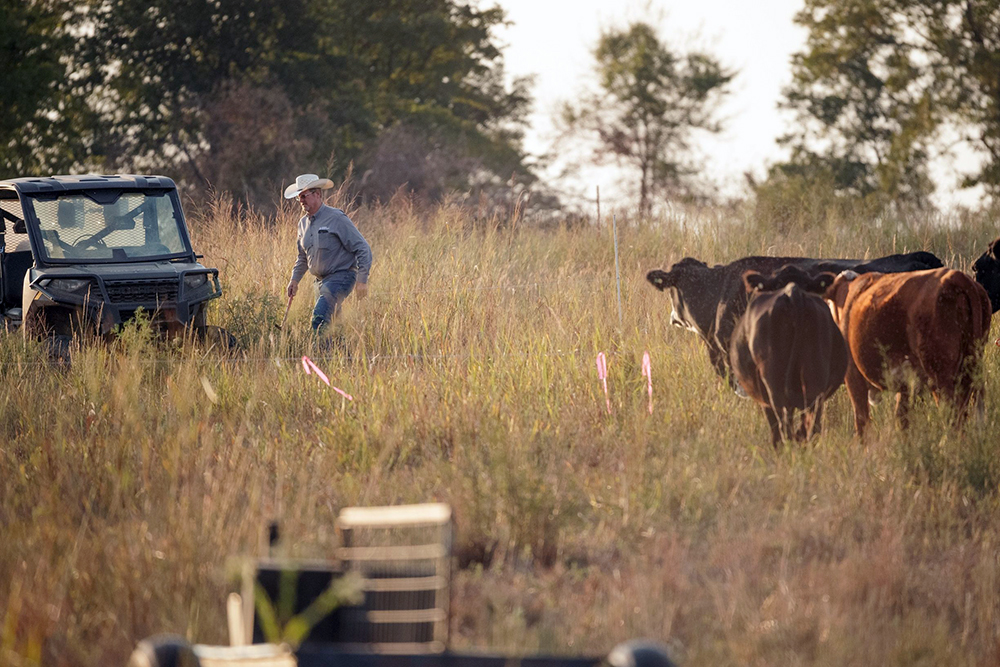
What You Can Feed and What You Do Feed
Pretty often, Ford hears ranchers use carrying capacity and stocking rate interchangeably. Which can mislead ranchers into overgrazing their land. For example, using a rule of thumb for stocking rate, like running one cow for every 10 acres of land, isn’t necessarily the same herd size that would be determined by correctly calculating your carrying capacity.
“In our classes, we talk about carrying capacity as the maximum number of animals you can run based on certain criteria,” says Ford.
In the classroom, Ford uses an analogy to help ranchers visualize the difference between the terms. He pulls up an image of a stock trailer. In this scenario, the trailer is rated for 12,000 pounds of cargo — so 12,000 is the trailer’s carrying capacity. He clicks through the graphic to show several animals loaded on the trailer. With the maximum carrying capacity of 12,000 pounds of cargo loaded, the trailer is about three-quarters full.
Clicking again to advance the graphic, a few more animals are added to fill the trailer. It now holds 16,800 pounds of cargo — a “stocking rate,” if you will, that is well over its carrying capacity. Ford talks about what could go wrong in this scenario.
“We’re going to wear out our bearings or springs or tires. We’re going to blow out these tires eventually and be stranded somewhere,” he says. “And that’s the same thing with our carrying capacity. If we set our stocking rate too high, especially if it goes over our carrying capacity, then we start harming the microbes and fungi and all those living organisms in the soil.”

Critical Calculations to Prevent Overgrazing
The first criteria is grazable acres. Rather than using every acre of your ranch to determine carrying capacity, you’ll want to narrow that number down to just the acres that provide forage for your animals. Non-grazable acres include a homestead area, roads or lanes, wooded areas and even oil or gas drilling pads.
Next, you’ll want to know your forage production per acre. There are several ways to determine your ranch’s forage production if historical records aren’t available from past grazing or haying seasons.
“You can go back to the old grazing sticks — that’s a decent way to get a baseline measurement. For a digital approach, you can go to the USDA’s Web Soil Survey website or Rangeland Analysis Platform to get a baseline forage production number,” says Ford.
The critical piece that ranchers are most in control of is utilization, or how much forage you plan to use. This is calculated as a percentage. Ford recommends setting your utilization rate to something below 50%.
To calculate how much your herd eats, determine the average weight of your livestock and multiply by a standard intake percentage.
“If you’re running cow-calf, we’ll typically suggest using 2.6% to 3%,” says Ford. “When I was in college, we talked 3%. It’s changed; now a lot of people are saying 2.6%. Either number is a good place to start, but if you use 3%, you’re a little bit safer.”
Then multiply the average daily intake by the number of days you plan to graze. Ranchers who don’t plan to substitute grazing with hay would multiply by 365.
“Once you do all the math, it will tell you how many animals your operation can run,” says Ford. “Quite often, that’s an awakening moment for people.”
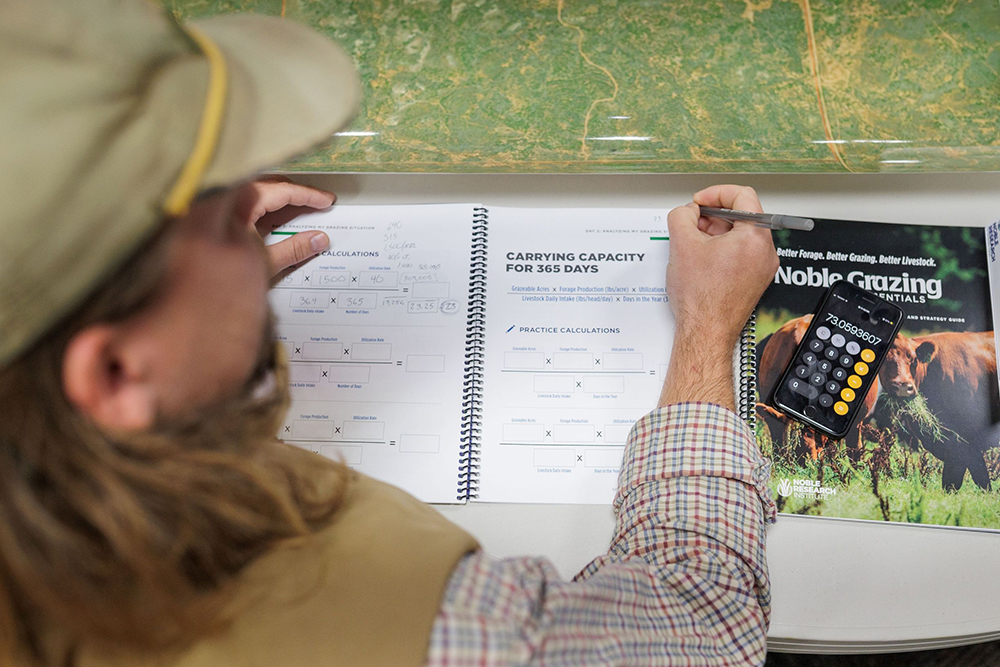
Determine Your Stocking Rate From Carrying Capacity
Knowing your ranch’s carrying capacity for the year can support soil health and grazing goals. There are a few other things to consider when right sizing your ranch’s herd.
“Some people want to set their carrying capacity at 100%,” says Ford. “But what if you get any years of drought? That’s not going to be good. One thing we’ve got to keep in mind is that since carrying capacity is heavily dependent upon forage production, it’s also heavily dependent upon rainfall and climate.”
Carrying capacity can change annually and seasonally as precipitation and degree days ebb and flow. Ford recommends stocking ranches at some percentage below carrying capacity.
“Say you set your stocking rate at 80% of carrying capacity. Then, if you get in a drought situation, you may be able to weather that drought based on the forage you already have without selling cows.”
Alternatively, in good years, Ford says there are opportunities for ranchers who have more grass than they need. Ranchers can either bring in another enterprise, like stocker calves, or do some custom grazing. Ranchers also may choose to do a little soil health management via prescribed fire or additional rest of a pasture. Ford admits that reducing your herd size to optimize an operation can be a tough concept for ranchers to accept. But often, when ranchers run the numbers, they find that aligning their stocking rate with their ranch’s carrying capacity pays off in the long term.
Editor’s Note: This is part of a continuing series of articles about regenerative ranching from Noble Research Institute, long trusted by beef cattle producers for supporting the industry with research, education and consultation. Follow the series in future issues of Baldy Advantage and Hereford World, as well as in special “1881” podcasts, at Hereford.org. Additional regenerative resources and past articles in the series are also at Noble.org.

Laura Brenner
Laura Brenner, Sr. Content Writer
Laura Brenner is a senior content writer for Noble Research Institute. She’s worked in agricultural communications for over a decade, specializing in nonprofit communications and storytelling. Laura earned a bachelor’s degree from Penn State University and a master’s degree from Purdue University. She resides near her hometown of Lancaster County in south-central Pennsylvania.
Comment
Leave a Reply
2 comment on: "Carrying Capacity Versus Stocking Rate: Getting the Numbers Right""
Melvin Don Henson
January 6, 2026enjoyed working that direction,improved pasture large amount of forage spring summer not enough cattle to utilize need options
Ralph Noble
January 6, 2026Very important information for those in my area where most cattle producers run cow-calf operations. With beef calf prices where they are today, we have been seeing land owners considering increasing their herd size without increasing their land or management. It can develop into a train wreck.
Thank you!