
Science and Community-Building Bring Pecan Growers to Ardmore
Originally organized to bring together pecan growers involved with Noble's Pecan Research Project, the 2026 Pecan Producer Workshop grew exponentially to include curious growers and soil health-focused researchers from around the region.
Pecan producers and researchers joined Noble Research Institute staff in Ardmore, Oklahoma, for the fourth annual Pecan Producer Workshop. The workshop, hosted in early May 2026, started as an event exclusively for partner producers of Noble’s Pecan Research Project. Noble hosted more than 50 attendees from Georgia, Oklahoma and Texas, making it the largest workshop to date.
The three-day workshop offered live-recorded sessions for in-person and virtual attendees, as well as field tours and an interactive light trapping demonstration.
“It was great to see the strong engagement from producers and their appreciation for the important research done,” says Maria Silveira, director of research at Noble. “I also want to thank the researchers and institutions who helped support the Pecan project and workshop.”
Topics spanned soil moisture science, soil ecosystem health and microbiology, data-driven orchard management, regenerative marketing strategies, real-world orchard management strategies and pecan grower economic modeling — with Q&A sessions that pushed the conversation in directions only producers can.
Lauren Jones, Ph.D., senior research associate and event organizer, says this workshop is an opportunity for producers and researchers to get to know people in the pecan industry.
“This is one of those opportunities where we get to come face-to-face with everybody in our network — folks who identify as traditional, sustainable, climate smart or regenerative-minded. We talk about what those efforts are, what their success and failures are, and we try to tie in research about soil health, tree health, nut health and profitability,” says Jones.
The keynote speaker was Texas A&M professor and horticultural sciences department head Amit Dhingra, Ph.D. To some, Dhingra represents a significant change for the A&M horticulture department, refocusing the research on sustainability. He spoke about the history of agronomic invention and sustainability, starting with Norman Borlaug and William Vogt. Dhingra also discussed modern advances in regenerative management practices, including his research using biochar to stimulate soil biology.
“What an impactful platform,” remarked Dhingra after the event. “All the sessions I attended were very informative and I learned a lot, with much more to learn. I hope to be able to join again next year.”
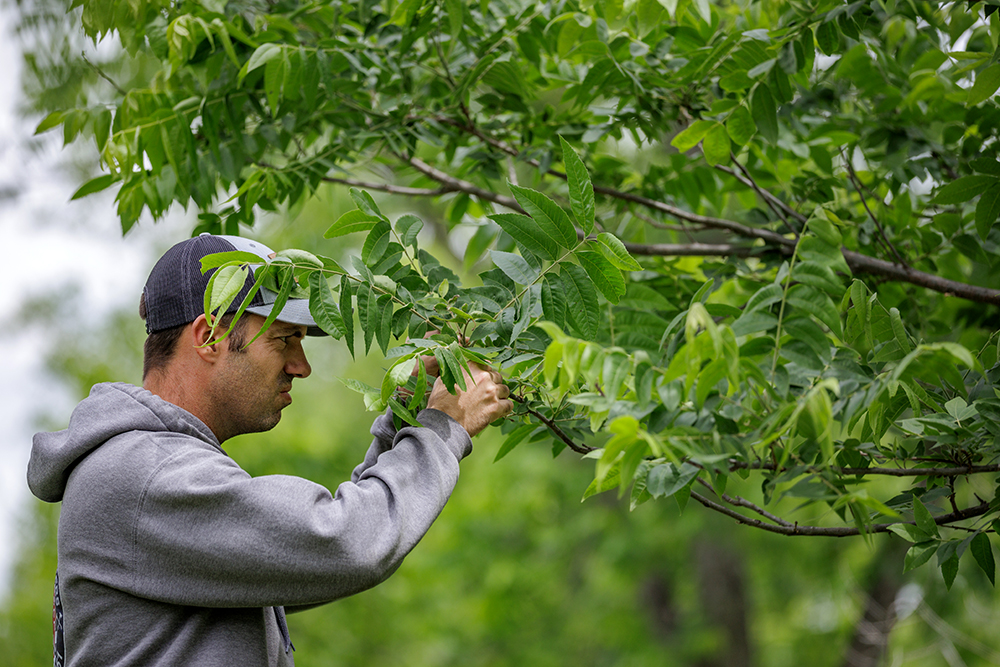
Researchers from Noble shared updates from ongoing projects, including bat guano research, nut nutrient analysis, orchard economics and profitability, and connections between soil health and tree health.
“Insights and questions from the annual Pecan Producer Workshop continue to shape the Pecan Research Project as we collaborate with producers and learn from their journeys already underway,” says Jones.
New to this year’s event is the inclusion of university researchers sharing their work. Kim Cervantes, Ph.D., and Kyle Slusher, Ph.D., both from Texas A&M, spoke about the environmental and pest challenges confronting West Texas’ pecan industry. Texas State researchers Samira Islas Valdez, Ph.D., and Canyon Tillmon provided updates from research on the effect of organic amendments on soil microbiome and practical uses of bats for pecan orchards, respectively. Auburn University professor emeritus and consultant Bill Goff, Ph.D., joined Noble’s Silveira to discuss data-driven management and decision-making.
Producer panelists shared perspectives from their own regenerative journeys, grounding the research data in what’s happening on the ground. Acclaimed growers also discussed their successes and lessons learned, answering questions from other curious producers.
“The continuing maturation of the [Pecan Research] Project is evident in the data produced and the participation level at Noble. Four years of data and analysis are now becoming meaningful,” says Troy Swift of Swift River Pecans. He’s a producer collaborator in Noble’s Pecan Research Strategy and one of the producer panelist members. Swift is well known for his embrace of regenerative management that focuses on soil health as a means to healthier trees.
“Farmer participation [at the workshop] is increasing in terms of attendance, education and willingness to discuss/present topics of interest,” says Swift. “I very much look forward to participating in the remaining years of the project. I believe that this long-term study will reveal the potential soil health can provide for agriculture.”
The workshop extended beyond the classroom, with tours and demonstrations both on-site and at Noble’s nearby Conrad-McMillan Orchard.
Tours at the Noble Retreat Center and Conrad-McMillan Orchard gave attendees a close look at functioning bat houses in different settings. While currently empty, the shelters have housed bats in past seasons. “The bat houses at Noble had bats in them up until very recently. But they fly, you know. We’re hoping that they come back eventually,” says Jones.
David Miller, farm manager at Conrad- McMillan Orchard, led a tour focused on the integration of livestock in the orchard. Miller manages a flock of sheep within and around the orchard to maintain ground cover under the trees and improve soil health. On the heels of that tour, regenerative ranching advisor Charles Rohla, Ph.D., and former professor and veterinarian Mike Willard, Ph.D., shared a presentation about animal husbandry and orchard livestock management.
“Integrating livestock can be a hard sell to pecan growers because they’re not a typical rancher,” says Rohla. “Once you show them how livestock can impact the nitrogen cycle without using synthetic fertilizer, they were interested in the idea.”
Rohla said Willard joked the two were the “good cop, bad cop” of livestock integration. Rohla, the good cop, shared the benefits to soil health, the nitrogen cycle and less time spent mowing. Willard, the self-proclaimed “bad cop,” reminded the room just how dangerous and troublesome it can be to own cattle, sheep or the like.
Rohla’s best advice? “Start small. One orchard that did just integrate livestock started with four head of cattle. It’s not enough to get the impact they need, but it’s a good start to learning the animal. I always tell people to choose something you’ll be comfortable with. Learn and gradually get bigger as you see it’s working.”

Thursday night brought an interactive light trapping session led by Texas A&M entomologist Kyle Slusher. This gave the group a firsthand look at the insect populations living on the Noble campus near the bat houses. It’s a reminder that understanding what’s living in and around a pecan orchard is just as important as what’s happening in the soil beneath it.
With more than 50 producers and researchers at the workshop, the opportunity for learning and connection extended beyond the structured sessions. Growers commiserated over droughts they’ve experienced and how they made do. A couple of producers chatted about navigating the tricky conversations with family and neighbors about their decision to focus on soil and tree health. The personal story from the producer whose failing conventional orchard led them to dive — feet first — into regenerative management drew the ear of many. It could be said that the side conversations were as enlightening as the sessions.
“Thank you for the great pecan growers’ workshop,” wrote attendee Dennis Perz of Georgetown Pecans. “Your agenda was excellent, and the combination of scientists and growers was certainly a winner: enjoyable and instructive. Bringing in attendees like Dr. Dhingra and Dr. Bill Goff contributed significantly to the value I derived.”
Laura Brenner
Laura Brenner, Sr. Content Writer
Laura Brenner is a senior content writer for Noble Research Institute. She’s worked in agricultural communications for over a decade, specializing in nonprofit communications and storytelling. Laura earned a bachelor’s degree from Penn State University and a master’s degree from Purdue University. She resides near her hometown of Lancaster County in south-central Pennsylvania.
Comment