
The Message in the Weeds
Before asking how to kill a weed, many land managers first ask why it's there. The answer may reveal opportunities to improve land health and profitability.
Most producers have had the experience. You’re driving through a pasture when a patch of ragweed catches your eye. Or maybe it’s sandbur creeping into a grazing paddock or thistles standing above the forage canopy. Your mind shifts to a familiar question: How do I get rid of it?
But what if instead the question was: Why is it here?
“We’ve been conditioned to see weeds as a nuisance,” says Sky Toney, regenerative ranching advisor with Noble Research Institute. “A lot of folks are treating the symptom when they see weeds pop up. Instead of fixing that root issue, they’re just battling weeds all day.”
Weeds are often viewed as a problem, but Toney compares them to a scab.
“If you think about the soil as your skin, weeds are kind of nature’s scab,” he says.
Just as a scab protects a wound while healing occurs underneath, many weeds move into disturbed areas to cover bare ground, capture sunlight and rebuild ecological function. Ecologists call this succession. As soil health improves, one plant community often prepares the way for the next.
The same traits that allow a weed to thrive in a stressed environment can also help repair it.
This shift from seeing weeds as enemies to viewing them as indicators, and sometimes even allies, is one of the more surprising lessons producers encounter as they begin looking more closely at the relationships between soil health, grazing management and plant communities.
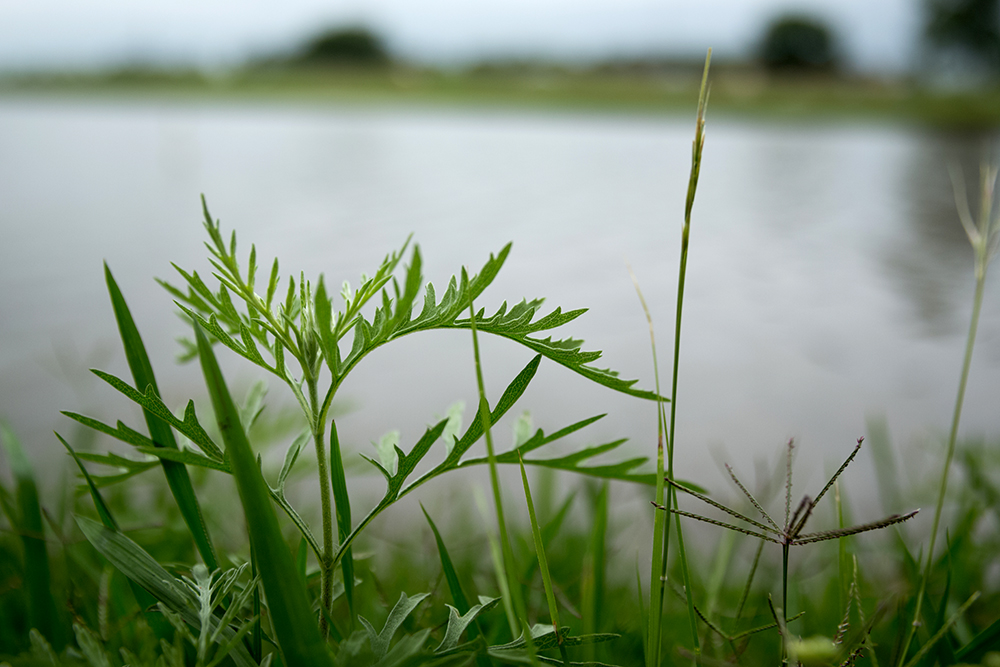
Ragweed
Western ragweed is often associated with areas experiencing chronic overgrazing or soil compaction. When desirable perennial plants struggle, opportunistic species like ragweed gain a competitive advantage.
But focusing only on the plant can cause producers to miss the bigger picture.
“I was at an operation that had a lot of ragweed and silverleaf nightshade,” Toney says. “They were just trying to get rid of it year after year, but they weren’t dealing with the root cause, which was overgrazing and soil compaction and low organic matter.”
Once grazing management changed and plants were given adequate recovery time, the pasture began to shift. Within a few seasons, the weed pressure largely disappeared.
“The weeds were there telling us something,” Toney says.
Ragweed can also provide more value than producers realize. Toney says sheep, goats and cattle readily graze giant ragweed on his operation.
He notes many weeds are simply plants livestock choose not to eat under conventional grazing systems because they prefer other options. Under different grazing strategies, many of those same plants can become valuable forage.
Sandbur
Few pasture plants are as frustrating as sandbur. Yet from an ecological perspective, sandbur often functions exactly as nature intended.
It frequently appears in disturbed, exposed or stressed soils. Overgrazing, drought, erosion and mechanical disturbance can create opportunities for the plant to establish.
“You very rarely see sandbur come in in a really healthy system that has a lot of perennials and a lot of cover and good soil organic matter,” Toney says.
In other words, sandbur may be less of a weed problem and more of a bare ground problem. That doesn’t make it desirable, but it does make it informative. Like other early successional plants, sandbur quickly occupies open space. It protects exposed soil, captures sunlight and begins the process of rebuilding organic matter.
“It’s better than having nothing, better than having bare ground,” Toney says. “It’s photosynthesizing; it’s eventually adding some organic matter. It’s doing something with nutrient cycling.”
Sandbur isn’t the goal, but it can reveal underlying conditions allowing it to thrive. As soil cover improves and desirable forage species become more competitive, sandbur typically becomes less prevalent.
“We’re always thinking about what the root cause is,” Toney says.
Thistle
During a recent Noble soil health course, participants dug up a thistle and examined its root system. Many were surprised by what they found.
“They’d always seen thistles as only a weed that they had to manage and deal with and kill,” Toney says.
What they discovered was a plant performing several important ecological functions.
Many thistle species often appear in disturbed, compacted or overgrazed soils. Yet the same deep taproots that allow them to survive those conditions can also help improve them. Their roots penetrate compacted layers, create channels for water infiltration and pull nutrients from deeper soil horizons.
“The things that we see as a problem are actually the solution to the underlying issue,” Toney says.
The benefits extend beyond the soil. Thistles provide valuable habitat and food sources for pollinators, insects, birds and other wildlife. Toney says it’s rare for him to inspect a blooming thistle without finding multiple insect species using it.
The plant even played an unexpected role at Noble’s Red River Ranch. In 2023, after the ranch transitioned toward regenerative management, a large population of musk thistle emerged. Rather than spraying, the team chose to observe. Later that spring, a grasshopper outbreak arrived.
The grasshoppers stripped the leaves from the musk thistles before moving on, leaving much of the surrounding forage intact.
“We actually had grass that survived the grasshoppers under the musk thistle,” Toney says. “That saved our bacon.”
The experience reinforced a lesson that producers learn repeatedly: Diversity creates resilience. In this case, the thistles served as an alternative food source, helping protect other forage species during a period of intense insect pressure.
Curiosity Before Control
There is no one-size-fits-all solution. Instead, producers are encouraged to observe conditions and understand potential causes before taking action.
“At Noble, we are not giving you a prescription for how you need to address this issue,” Toney says. “What we’re trying to do is educate you on the principles and the why behind all of this.”
That process begins by identifying the plant, understanding what conditions may favor it and evaluating whether management practices such as grazing pressure, recovery periods, soil disturbance or plant diversity are influencing its presence.
The goal is not simply to remove weeds but to understand what they are communicating. For Toney, the conversation often comes back to profitability. Diverse plant communities can provide forage, support wildlife, improve nutrient cycling and reduce dependence on purchased inputs.
“Why pay for something and spend the time and money to do something that nature will do for free for you?” he says.
Noble refers to this as a “safe to learn, safe to fail” approach. Rather than betting the whole operation on a new strategy, producers can test ideas on a small scale, observe results and adapt based on their own context.
Every ranch is different. What works in one environment may not work in another, even when both operations are guided by the same principles.
The next time an unwanted plant appears in your pasture, consider looking at it a little differently. It may be more than a weed. It may be a clue about the condition of your land and, in some cases, a partner in helping move it toward greater health, productivity and profitability.

Maddy Westbrook
Maddy Westbrook, Sr. Content Writer
Maddy Westbrook is a senior content writer for Noble Research Institute. She grew up in the Texas panhandle as the fifth generation of her family’s farming and cattle feeding business before earning her bachelor’s degree in agricultural communications from Texas A&M University. Maddy’s experience spans marketing and communications within the agricultural commodity and food and beverage industries.
Comment